Why Accurate Legal and Medical Transcription Requires Human Transcriptionists
By: Krystal Bacaltos Published:In most industries, a transcription error is a nuisance. In legal and medical work, it can be something much more serious. A misheard drug name, a misspelled statute, a garbled expert’s name in a deposition — these aren’t just typos. They’re the kind of mistakes that require correction before a document goes anywhere, and finding them takes time that most legal and medical professionals don’t have to spare. Accurate legal and medical transcription isn’t a nice-to-have. It’s a basic requirement of the work.
At Speechpad, every file is handled by a human transcriptionist — someone who listens, reads, and applies judgment to what they’re hearing. That distinction matters most in fields where the vocabulary is dense, the proper nouns are unforgiving, and the stakes of getting it wrong are real.
What Makes Legal and Medical Transcription Different From General Transcription?
Legal and medical recordings contain specialized vocabulary, proper names, and document conventions that require subject matter familiarity — not just careful listening. Errors in these fields carry professional and legal consequences that errors in general transcription typically don’t.
A deposition might include the names of multiple attorneys, expert witnesses, and parties whose names need to be spelled correctly and consistently throughout. It might reference case citations, statutes, and regulations. It might include Latin phrases that are standard in legal writing but easy to mishear. The person transcribing that recording needs enough familiarity with legal language to recognize what they’re hearing and render it accurately.
The same is true for medical recordings. A physician’s dictation might include drug names with near-identical pronunciations but entirely different spellings and uses. Anatomical terms, procedural names, and diagnostic codes follow conventions that require knowledge to apply correctly. Patient names often include diacritical marks — accents, umlauts, tildes — that belong in the record and matter to the person whose name it is.
What Types of Errors Are Most Common in Legal and Medical Transcription?
The most consequential errors in legal and medical transcription happen with proper names: medication names, case citations, party names, and anatomical or procedural terms that sound similar to unrelated words.
Medication names are a clear example. Many drugs have names that sound similar but refer to completely different compounds. The difference between “Celebrex” and “Cerebyx,” for instance, is not something you can guess from audio alone. A transcriptionist without medical vocabulary familiarity will produce a plausible-sounding name that may or may not be correct. In a medical record, that matters.
In legal work, case names and statutory references have to be exact. A transcript that renders a well-known case name phonetically rather than correctly creates a document that requires review and correction before it can be used. In multilingual legal contexts — immigration proceedings, international arbitrations, cases involving parties whose names include diacritics — those names need to appear in the record as they actually are, not as they sounded to someone unfamiliar with the language of origin.
How Does Speechpad Handle Specialized Legal and Medical Terminology?
Speechpad matches files to transcriptionists based on subject matter familiarity. Qualified transcriptionists earn specialized designations in medical and legal work through a structured vetting and performance review process. Files go to people who recognize the terminology they’re hearing — not just people who are fast typists.
This matching process is what separates accurate legal and medical transcription from general transcription services. It’s not enough to be careful. The transcriptionist has to know that “Cerebyx” and “Celebrex” are two different drugs, that a case citation format follows specific conventions, and that a patient’s name with an accent mark should carry that mark through the entire document.
Does Speechpad Transcribe Patient Names With Diacritical Marks?
Yes. Speechpad’s human transcriptionists place diacritical marks — accents, umlauts, tildes — correctly in patient names and other proper nouns as part of the standard transcription process.
This level of detail isn’t something most transcription services advertise, because most don’t do it consistently. Speechpad clients have noted receiving transcripts with diacritics placed correctly without having to ask — including in multilingual content with culturally specific proper nouns. For medical records and legal documents where names must appear accurately, this matters.
How Much Time Does Accurate Transcription Actually Save Legal and Medical Teams?
When a transcript comes back accurate the first time, it goes straight into the workflow. When it doesn’t, someone on your team spends time finding and fixing errors — time that’s rarely accounted for when evaluating transcription services, but is real.
Speechpad clients consistently report needing only minor edits, if any, after receiving completed transcripts. One client noted that after reviewing a completed batch, only a few minor corrections were needed across the entire set. Another described the service as highly accurate at a very reasonable price — with turnaround that regularly came in ahead of schedule.
For legal and medical professionals billing their time carefully, the math changes when you factor in correction time. A less expensive service that requires an hour of review per transcript isn’t less expensive in practice.
How Long Does Legal or Medical Transcription Take With Speechpad?
Speechpad’s standard turnaround is 24 hours. Rush options are available for time-sensitive filings, depositions, or clinical documentation needs.
Legal and medical work often comes with firm deadlines — deposition transcripts needed before a filing date, clinical notes that need to be in the record before a follow-up appointment. Speechpad clients regularly note that turnaround comes in ahead of the promised window, not just within it.
How Much Does Speechpad’s Legal and Medical Transcription Cost?
Human transcription at Speechpad starts at $1.30 per minute. A legal formatting add-on is available at an additional $0.45 per minute. Volume pricing is available for practices and firms with ongoing transcription needs.
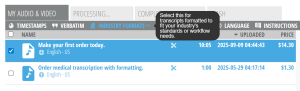
To add legal and medical formatting to your transcription orders, select the files you want to order from your dashboard. Click the “Industry Formats” menu item in the toolbar, then choose either “Legal” or “Medical” format. This applies specialized formatting and ensures accurate handling of legal and medical terminology throughout your transcript.
For questions about specific file types, format requirements, or high-volume pricing, the support team is responsive and can be reached directly. Speechpad clients regularly note that questions and requests are handled promptly — not routed through a slow support queue.
Frequently Asked Questions
What types of legal recordings does Speechpad transcribe?
Speechpad transcribes depositions, hearings, court proceedings, attorney dictation, client interviews, and other legal audio and video recordings. Files are matched to transcriptionists with legal subject matter familiarity.
What types of medical recordings does Speechpad transcribe?
Speechpad transcribes physician dictation, patient interviews, clinical notes, research recordings, and medical conference sessions. A medical formatting add-on is available for records that require specific documentation standards.
Does Speechpad offer confidential transcription for legal and medical files?
Yes. Speechpad’s transcriptionists operate under confidentiality agreements. For specific compliance or security requirements, contact the support team directly to discuss your needs before submitting files.
What audio quality does Speechpad require for legal and medical transcription?
Speechpad’s human transcriptionists handle recordings with background noise, multiple speakers, and varying audio quality — conditions that create problems for automated transcription. For best results, recordings should be as clear as possible, but difficult audio can be submitted and the support team can advise on expected accuracy before you proceed.
Can Speechpad handle multi-speaker legal recordings like depositions?
Yes. Human transcriptionists identify and label individual speakers in multi-party recordings, which is important for depositions and proceedings where speaker attribution is part of the official record.
Ready to Work With a Transcription Service That Gets the Details Right?
Human transcriptionists, 24-hour turnaround, starting at $1.30/min.
Or email us at support@speechpad.com